Planning reactions and the lab journal

Planning the reactions (Author: Ruixu Mu)

Author: Ruixu Mu,

Effective experimental planning is the keystone of successful chemical synthesis, bridging theoretical design and practical execution. Unlike intuitive trial-and-error approaches, systematic planning involves the iterative refinement of stoichiometric parameters, reagent compatibility, and scalability constraints—all grounded in rigorous literature analysis and quantitative calculations.

We have a framework that we adhere to. After you have decided the whole route of your reaction, you should draw out a scheme like this:
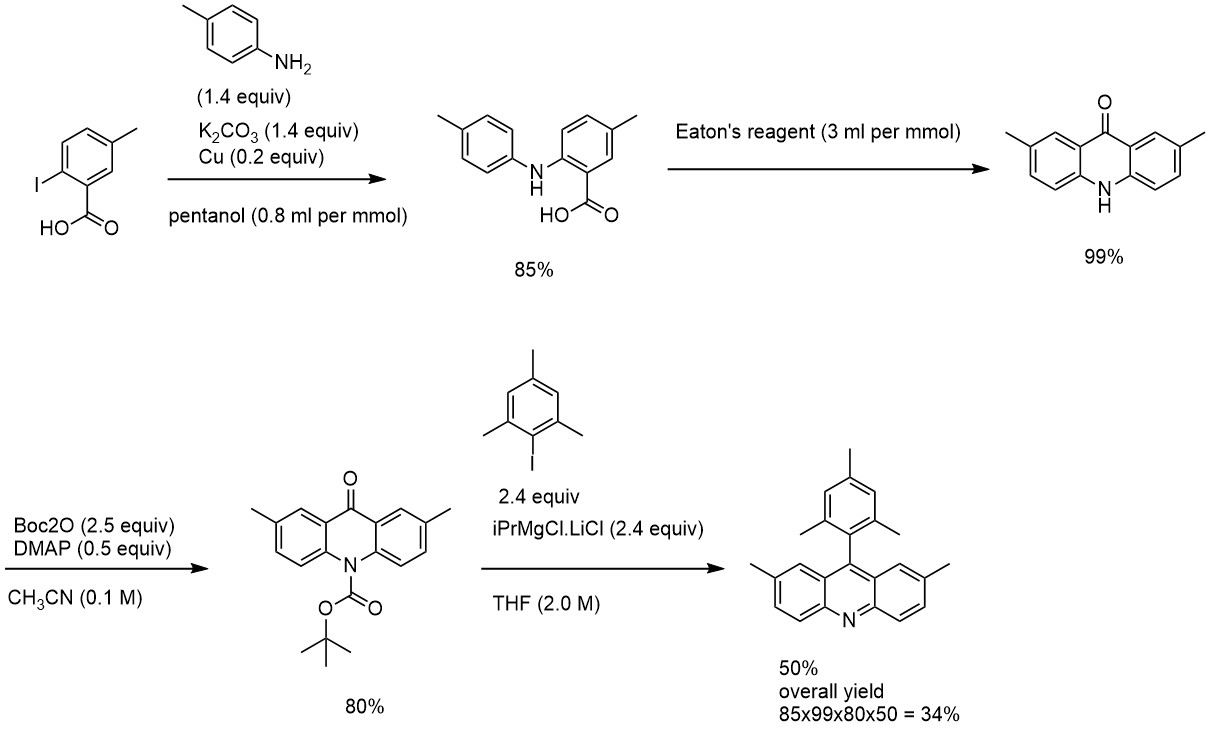
With the scheme in place, we can do the reaction plan. For the targeted 250 mg of final compound (or 0.76 mmol), considering an overall yield of 34%, the sequence should start from 2.2 mmol or 583 mg of iodobenzoic acid. Depending on skills and overall confidence in the reaction sequence, the amount of starting material can be adjusted. In most cases, a safety margin of 100% makes the reactions manageable. This means that a chemist can comfortably begin with 4.4 mmol or 1.2 g of starting material and arrive at the targeted 250 mg.

Accordingly, the entire sequence can be calculated: 660 mg of aniline, 850 mg of K2CO3, 52 mg of Cu, 11.2 mL of Eaton's reagent, 2.0 g of Boc2O, 225 mg of DMAP, 1.7 g of mesityl iodide, and 5.5 mL of iPrMgCl.LiCl.

Planning in this way allows for the logical purchase of starting materials and minimises delays due to the unavailability of reagents. Furthermore, the plan helps with the overall organisation of the work. If you realise halfway through the synthesis that you do not have enough material to finish, it might be worth investing time in repeating the steps to meet the goal of the synthesis.

Failing to plan is planning to fail.

Labjournal - the group standard (Author: Peter)

A lab journal is an integral part of the research and must be carefully prepared. We are using an electronic format at https://elabjournal.rug.nl/login/. On your first day, you will be provided with access and a three-letter code to label your experiments. Lab journaling is a transferable skill that is generally required in all branches and types of research.

We have a format to which we adhere to. Your experiment must include the following sections: heading, rationale for the experiment, scheme, procedure, notes and observations, and a section for uploading the raw data. Here is how to fill the sections:

Heading: Start with the three-letter code you got on your first day. Experiments are numbered in an incremental sequence, starting with the first experiment as 1. It doesn't matter if you're redoing a failed experiment. The number must be unique. If, for some reason, we need to revisit your experiment in a couple of months, it is essential to know whether it worked initially or if the experiment is sensitive.

Next, include a ChemDraw-generated name, allowing for a structural search. A nice bit of information to include is the scale and conditions.
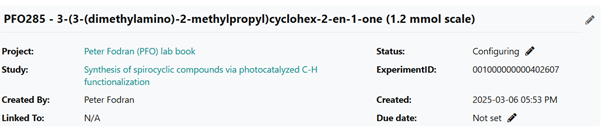
Rationale – really just one sentence that will make you think if the experiment is in the correct scale, relevant and moves the research forward
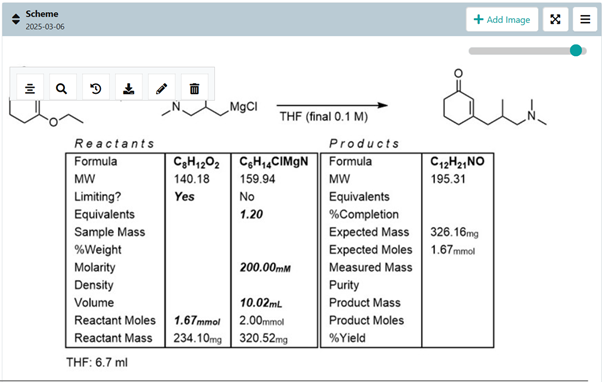
Scheme: Use ChemDraw and include all necessary reagents. Go to Structure -> analyse stoichiometry to generate the charge table. Fill in the charge table accordingly. This feature of ChemDraw is not flawless. For example, it cannot generate micro as a prefix but uses 2x mili. Overall, it is still helpful – when summarising the project for publication or the report, you must draw reaction schemes. In this way, you prepare them as you move through the project; thus, you will save time down the road.
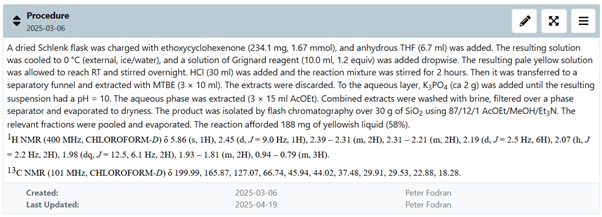
Procedure: Ideally, you write this as you are experimenting. Typically, there is plenty of waiting time during reactions, so why not write down what have you done? Style-wise, the procedure should be written in a passive voice because the action is more important than the person who did it. Limit the decimals to one digit. I prefer that the limiting reagent is written in mmols and the rest is in equivalents. It makes the procedure logical. Technically, the procedure has four distinct parts -the reaction part, work-up, purification and conclusions, which provide a logical structure. The reaction part describes how you set and conduct the reaction. Work-up describes all the actions that you have done from concluding that the reaction is terminated until you have a crude product.In most cases, this is some form of hydrolysis and extraction. Purification describes the operations you have done to obtain an acceptably pure compound. Conclusions provide information on the mass, yield in % and physical form of the target compound.

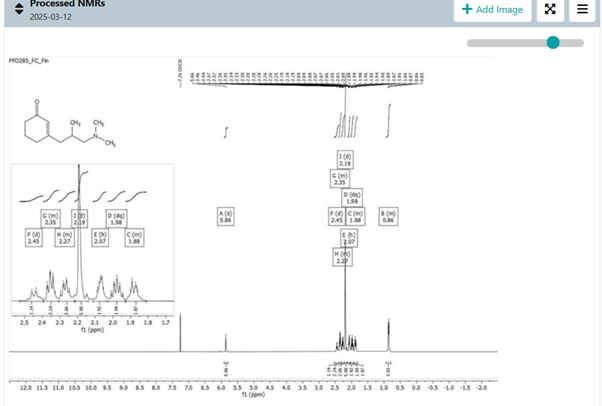
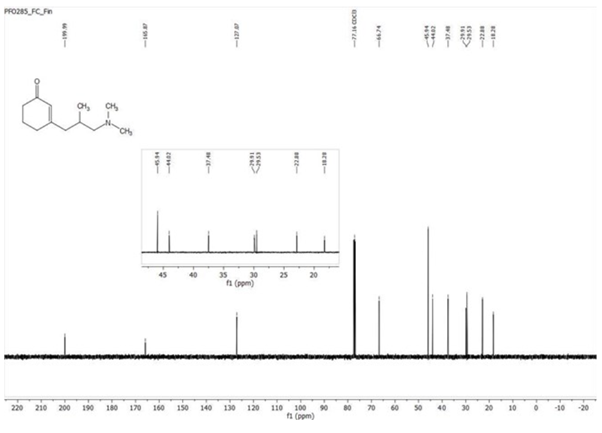
A well-written procedure also contains a write-up of the NMR spectra. A pro tip is to correct the typos and subscripts/superscripts as you write the procedure. It saves a lot of time.
The files section includes all the raw and processed data that you generate as you move through the experiment. 
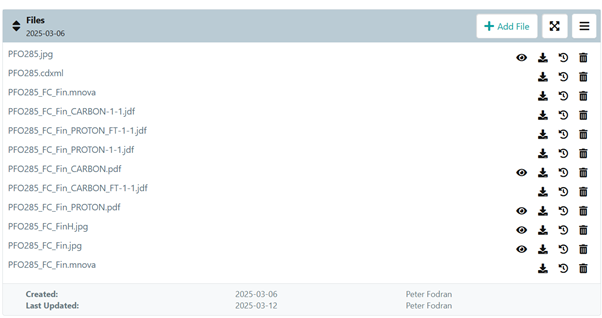
We must store the raw data in a form that makes it easy to retrieve. More importantly, there is a chance that you will have to revisit the experiments you did. If you pay attention and store even the processed data, it will save you a lot of time.

Next is the section for observation and conclusions. In the presented experiments, this is empty because the experiment went smoothly, and there were no issues along the way. Not all of them are like this, and that is natural. In this section, you can write notes for the next experimenter, which might make their life easier.
The bonus at the end – if you want to do outstanding work, you can place the processed data at the end of the experiment. For example:
Lab guide

General lab philosophy

This lab guide outlines the foundational philosophy, research practices, safety protocols, and expectations for working in our laboratory. It is intended to support both new and existing members in conducting responsible, efficient, and safe chemistry research.

In our lab, we strive to adopt sustainable practices from multiple perspectives. As this is a chemistry lab, the most essential way is to adhere to the green chemistry principle as much as we can:

  1. Prevent waste
  2. Atom Economy
  3. Less Hazardous Synthesis
  4. Design Benign Chemicals
  5. Benign solvents and Auxiliaries
  6. Design for Energy Efficiency
  7. Use of Renewable Feedstocks
  8. Reduce derivatives
  9. Catalysis
  10.  Design for degradation
  11.  Real-Time Analysis for Pollution Prevention
  12.  Inherently Benign Chemistry for Accident Prevention

These principles frame how we approach the research and how we conduct the reactions. We prevent waste by designing and executing experiments with high technical standards.

Exploring chemistry

Organic chemistry is an empirical science, and this shapes our daily activities. We search through databases, such as Reaxys or SciFinder, for suitable reactions. We assess whether they are suitable for the purpose and then implement them in our work.

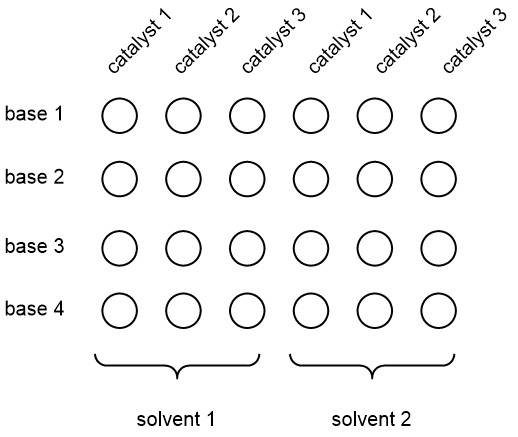
It is essential to execute the work in the most efficient manner possible. Always keep in mind the smallest number of experiments that will provide the desired answer. If you are exploring, for example, cross-couplings for the synthesis of the desired derivative, first collect the most common conditions, such as ligands, Pd salts, solvents, and bases. Set a small array (most common 24 vials) of reactions in parallel using 10-20 mg of the starting material. The goal is to be fast and cost-efficient. The following is an example of such an array:

UPLC-MS can conveniently evaluate 24 reactions in less than 2 hours. The first outcome is only a qualitative pass/fail. You look for the conditions that afford the desired product. Take the best conditions to the second round and attempt to achieve complete conversion of the starting material. The best conditions from the initial two rounds of screening can be scaled, and you can either try to isolate the product and determine its yield or use Q NMR to do so.

Lab safety

Safe handling of chemicals is essential, and there is little room for negotiation on this matter. When you enter the laboratory, you must put on the safety goggles. There are no exceptions to this. A research laboratory is a risky environment with apparatus either under vacuum or pressure. Furthermore, many reagents are harmful, toxic or allergenic. Common examples include coupling agents, such as DCC, EDC, HAT, and HBTU, which can act as allergens. These can cause nasty blisters to sensitive people. Another common class of reagents that are on the harmful/toxic continuum are alkylating agents – MeI, dimethylsulfate and benzyl halides. The purpose of this small introduction is not to make you afraid to work with chemicals, but to work with them safely and take all precautions to prevent any harm to your colleagues.

After putting on the safety goggles and lab coat, you are now ready to walk through the laboratory. Suppose you are going to set reactions, put on the purple nitrile gloves. These are great for working with solids. Although they are disposable, they can be reused several times, and it is a good practice to do so. If you need the heavy-duty “Marigold” gloves, they are also available. Marigolds are excellent for extractions, particularly when using chlorinated solvents. Now, being equipped with glasses, a lab coat and gloves, you are ready to set up your experiments.  Compounds are weighted using disposable paper sheets and plastic weighting boats. Once you are done weighing, throw them into the black bin and clean the area where you worked. iPrOH and paper are available next to the scale. When weighing compounds that are allergens, such as coupling agents, weigh them into a tarred, closed glass vial in a fume hood.

It is not permitted to work in the lab with contact lenses. The reason for this is that the material from which contact lenses are manufactured (PMMA, or polymethylmethacrylate) is soluble in common organic solvents such as AcOEt, THF, or DMF. In case of an accident in which any of these solvents are spilt in your eyes, they can dissolve and remain attached to your eyeball. The solvents can penetrate the contact lenses and remain trapped underneath, causing extensive irritation. Thus, remove the contact lenses when working in the organic chemistry laboratory. If you need prescription safety goggles, check with Peter.

Sharing of chemicals

Sharing chemicals is a tricky issue, especially if the level of care differs among lab members. However, it is essential that we do finish the reagents that we purchase and that during their lifecycle, they are in as good quality as possible. This holds particularly true for several classes of chemical products. First of all, material that comes in sealed bottles has to be used with a counterpressure of inert gas. Like this, the quality of the solvents and reagents is maintained. Secondly, hygroscopic compounds such as salts, acid chlorides, and similar substances. Purchase small packages. In this way, the turnover of the chemical will be rapid, and we will not accumulate decomposed chemicals. Follow the storage suggestions provided by the vendor. Storing the chemical under appropriate conditions is the responsibility of the person who requested the chemical.

The laboratory techniques

Safe handling of solvents and setting up a reaction

Solvents are essential components of reactions. They ensure that the reagents can come into contact during the chemical reaction, but they also have another important function. They help to dissipate the heat generated by exothermic reactions. In case you anticipate that the reaction is going to be exothermic, the execution of the experiment should address this. Dissolve the component that is freely soluble in the solvent, cool if necessary, and then add the reactive component, which generates an exotherm. Estimation of what dissolves well and what causes the exotherm requires some experience. Thus, when in doubt, check with Peter—an important note. In our laboratory, we use dried solvents purchased from the vendors. Usually, these solvents come with a bottle stoppered with a septum. The proper and only way we use these solvents in our laboratory is as follows. First, attach the bottle to the Schlenk line with an inert gas supply turned on. Puncture the septum with the needle. With another syringe, collect the required amount of solvent. Remove the syringe with solvent, and remove the supply of inert gas.

Never use these solvents without a supply of inert gas. Failure to do this results in moisture and oxygen contaminating the solvent bottles. Moisture is detrimental to the organometallic reactions; Oxygen is detrimental to photoredox. Both of these are core activities we perform, and we must have the tools in top-notch condition.

Monitoring a reaction

Monitoring a reaction - TLC, UPLC-MS, GC-MC, NMR

Work-up of the reactions

Work-up is the first stage of processing your reaction, where you hydrolyse the reactive intermediates and remove water-soluble components of your reaction. There is some inherent hazard in this stage, as exotherms and gases might form. When concerned about the reaction work-up ,check with Peter. Nevertheless, there are some general guidelines. First of all, if your work-up liberates gas, what is common when hydrolysing simple Grignard reagents, organometallic compounds, or hydrolysing reaction mixtures with mild aqueous bases such as Na2CO3 or NaHCO3. Pour the reaction mixture into the vessel with the hydrolysis solution. As this is usually done in conical flasks, the generated gas has plenty of space to escape. Performing the workup the other way around (in the reaction vessel) leads to a buildup of pressure and spraying of the reaction mixture. Some reagents, in particular POCl3, require extra attention; therefore, if you are working with these, please check with Peter. After the reaction mixture is hydrolysed, the organic components are extracted with organic solvents. Here a rule of the thumb – if you performed a reaction in solvent that is heavier than water (CH2Cl2, CHCl3), do the extraction in the same solvent—mixing solvents that are denser than water with solvents that are less dense than water leads to emulsions, which can be extremely difficult to break. If you performed the reaction in a solvent that is less dense than water (pretty much all the remaining solvents), try to extract with MTBE, AcOEt or AcOiPr. These are good alternatives to Et2O, which is not safe due to its volatility and flammability. Reactions performed in THF are somewhat special because THF does mix with water, but can be readily salted out. Thus, when working up THF reactions, the simplest work-up is to pour the mixture onto brine or a saturated NH4Cl solution. The phases separate, and the work-up can continue with routine extractions using an organic solvent. Once your organic phases are combined, wash with brine to pre-dry and filter over a phase separator. We prefer to use a phase separator over the conventional drying agents such as MgSO4 and Na2SO4. It is effective, does not require wash and generates significantly less waste than drying agents.

Evaporation

To ensure maximum efficiency in the evaporation of volatiles, we are using the 10/30/50 rule. The cooling water has a temperature of less than 10 °C, the bath has a temperature of 50 °C, and the vacuum is set to the boiling point of the volatile at 30 °C. This method is effective and enables the condensation of volatile solvents such as pentane, dichloromethane and Et2O. Sticking to this routine is extremely important when evaporating corrosive volatiles such as CF3CO2H. Correctly using equipment extends the equipment's lifetime, and the volatiles do not enter the atmosphere. After you are done with evaporation, turn off the rotavap to save electricity. Remember to clean the rotavap and empty the collection flask after you have finished evaporation.

Chromatography

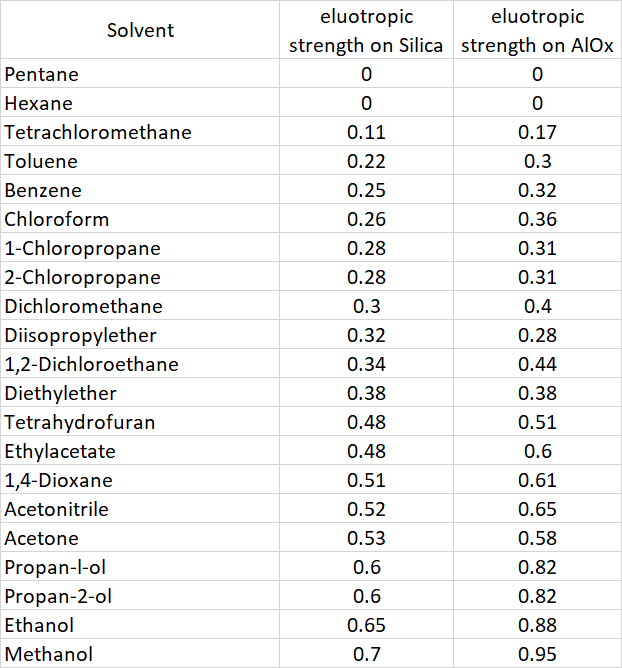
The biggest contribution we can make to reducing waste is by good chromatography practices. No matter what the vendors say and promote, isocratic elution is most of the time the most reliable. To achieve this correctly, identify an eluent that causes your compound to migrate to Rf = 0.3 with the best possible separation. If the difference between the Rf values is <0.1, use a 100x fold of silica vs the mass of your reaction mixture. If the difference in Rf is >0.3, 20-fold silica will be sufficient. Consider these as being the extreme values. Combine fractions based on the purity, not based on the quantity of material. Most of the time, we prefer to work with pure materials. A notable exception is when executing a multistep synthesis. If the compounds are difficult to separate in one step, but easy to separate in a subsequent step, carry over a mixture. It is a common misconception that every compound has to have perfect spectral data. A general guideline is that if the compound is important, it must be perfect. If the compound is an intermediate on the way to the important compound, sufficient data is good enough. When in doubt, discuss with Peter. Performing chromatography in this manner demystifies the process and eliminates a significant amount of frustration. The following table summarises the eluotropic strength of some solvents on silica and AlOx.

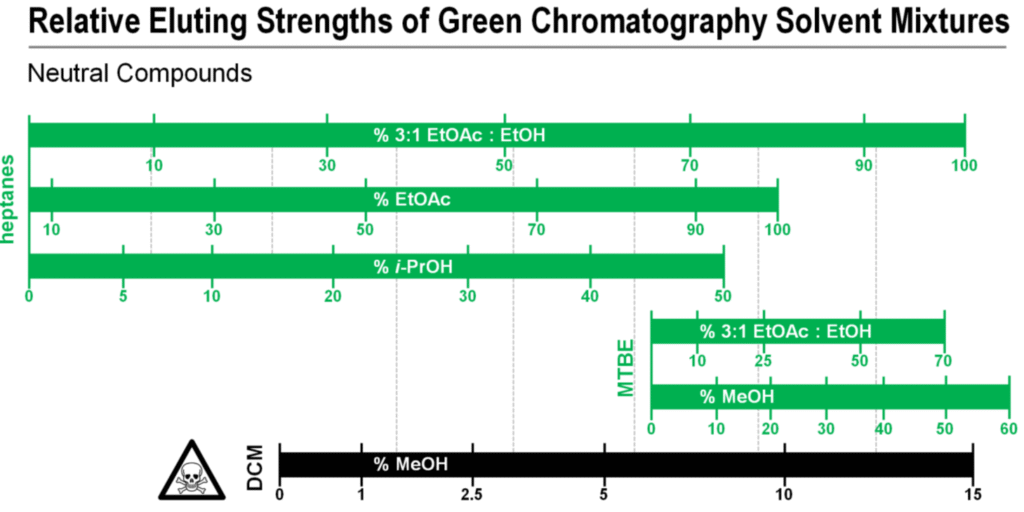
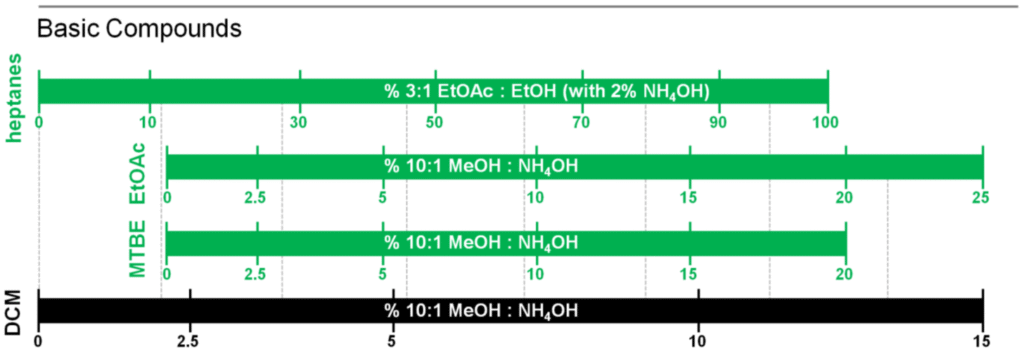
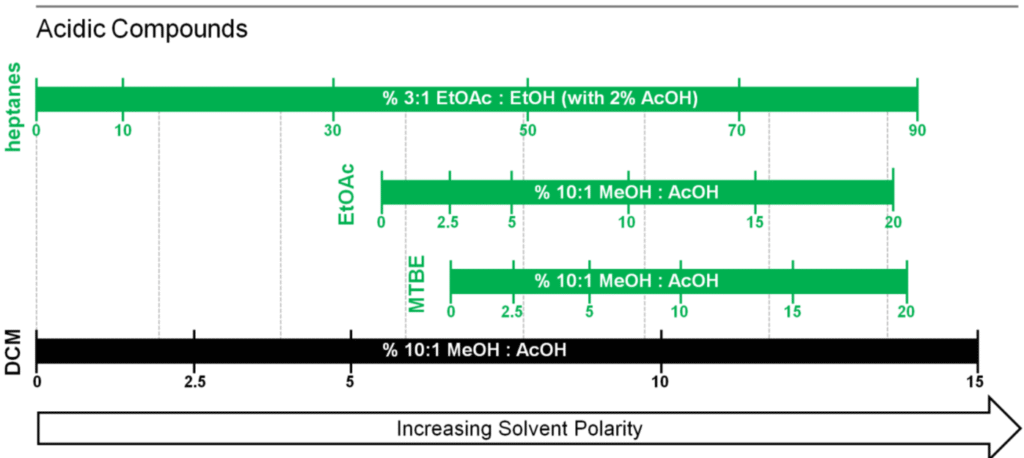
A special part of chromatography is dedicated to the use of CH2Cl2 or CHCl3 mixtures with MeOH. If possible, replace these mixtures with benign and sustainable mixtures of 3:1 EtOAc: EtOH and hydrocarbon. The charts below provide rough guidelines for the eluting strengths of the mix compared to the established chlorinated solvents mobile phase.